
From the first tooth to age 16
Four stages of growing up — Baby, Kids, Junior, Teens. Fluoride dosage, abrasiveness and flavor are tailored to each stage. Kids' pastes use mild surfactants instead of SLS.
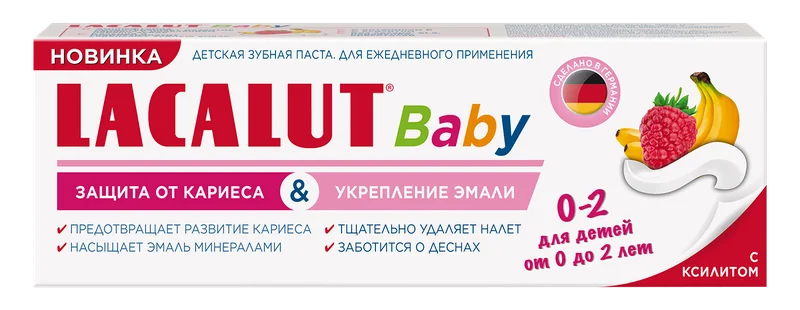
For the very first teeth: a mild formula that is safe if accidentally swallowed. Sodium fluoride and calcium glycerophosphate.
1000 ppm F · RDA 28 · 55 ml / 65 g
Cavity protection and enamel strengthening from the very first tooth: sodium fluoride and calcium glycerophosphate saturate the enamel with minerals, while xylitol supports cavity protection. The mild formula is safe if accidentally swallowed and cares for the gums.
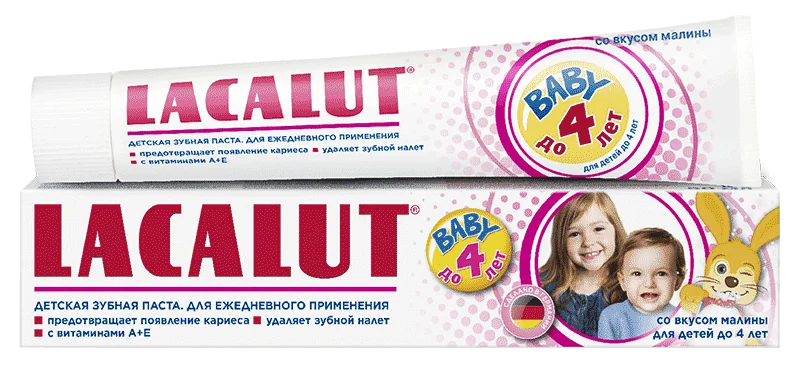
Olaflur only, with a minimal fluoride dosage — the gentlest option for toddlers.
250 ppm F · RDA 20 · 50 ml
A minimal dosage of the amine fluoride Olaflur — for toddlers who still swallow toothpaste. Raspberry flavor with vitamins A and E. Prevents cavities and gently removes plaque.
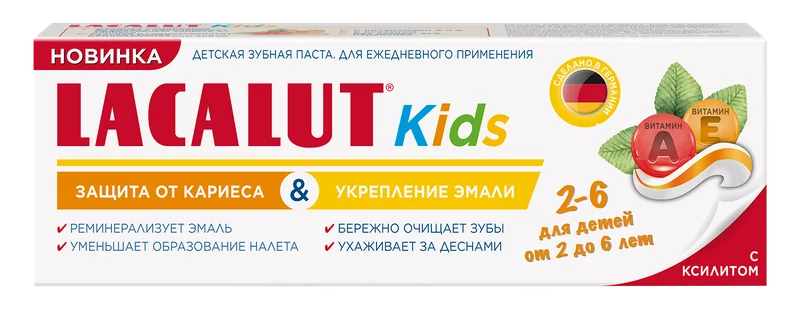
A triple mineral system: Olaflur, hydroxyapatite and calcium glycerophosphate — support for baby teeth.
1000 ppm F · RDA 17–40 · 65 g
Cavity protection and enamel strengthening: the triple mineral system (Olaflur, hydroxyapatite, calcium glycerophosphate) remineralizes the enamel of baby teeth. With xylitol; cleans gently and cares for the gums.
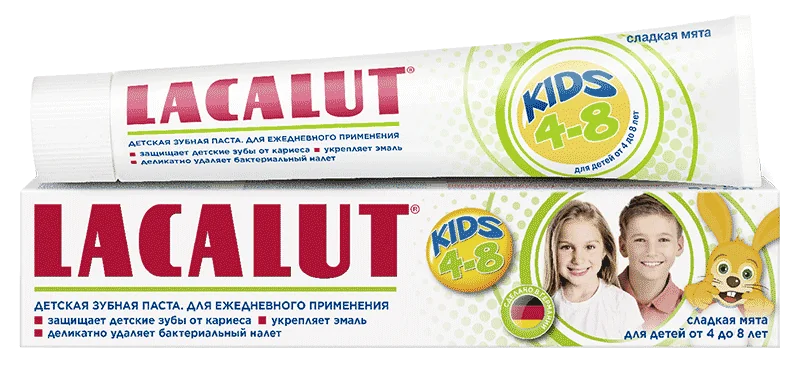
A formula for the tooth-replacement period: helps strengthen growing enamel.
500 ppm F · RDA 30 · 50 ml
For the period when baby teeth are being replaced: protects children's teeth from cavities, strengthens enamel and gently removes bacterial plaque. Sweet mint flavor.
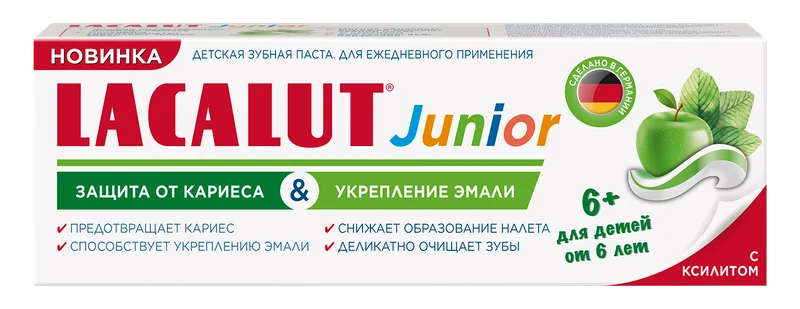
Support for permanent teeth during active growth.
1400 ppm F · RDA 32–58 · 65 g
Cavity protection and strengthening of permanent tooth enamel during active growth. Reduces plaque formation and cleans gently. Green apple flavor, with xylitol.
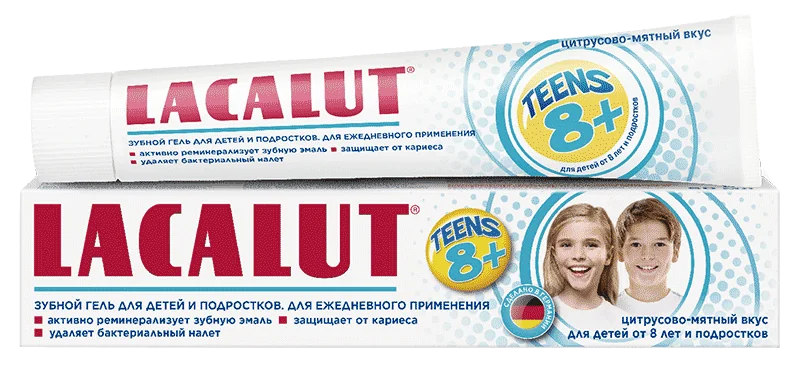
A tooth gel for teenagers — adult-level care in a teen format.
1400 ppm F · RDA 40 · 50 ml
A tooth gel for children and teenagers: actively remineralizes tooth enamel, protects against cavities and removes bacterial plaque. Citrus-mint flavor.
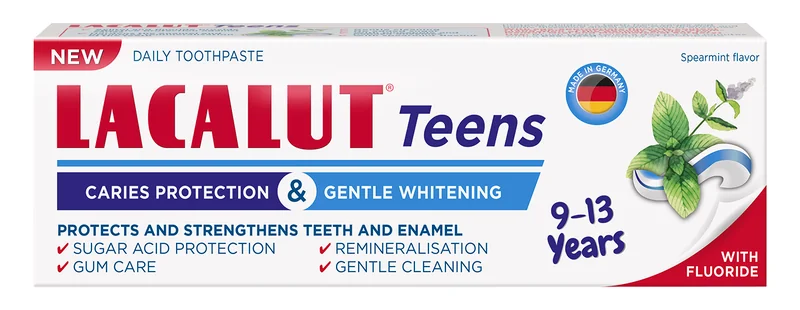
A dual-phase formula: cavity protection and gentle whitening. Papaya and pineapple enzymes softly brighten the enamel.
1400 ppm F · RDA 60 · 55 ml
New for 2026: a dual-phase formula — cavity protection and gentle whitening. Papaya and pineapple enzymes softly brighten the enamel, while fluoride strengthens it during the transition to permanent teeth. Mint flavor.
Also in the series
-
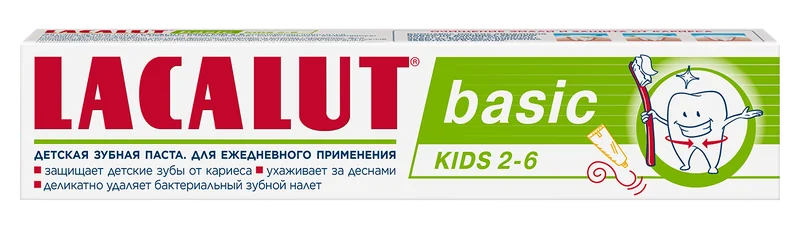 Lacalut basic kids 2–6
60 g
1000 ppm F · RDA 38
Lacalut basic kids 2–6
60 g
1000 ppm F · RDA 38
An affordable kids' toothpaste with fluorides and hydroxyapatite: protects against cavities, cares for the gums and gently removes bacterial plaque.
-
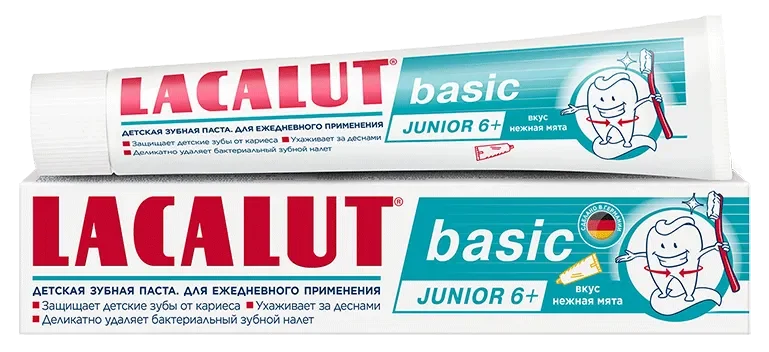 Lacalut basic junior 6+
gentle mint · 60 g
1450 ppm F · RDA 35–50
Lacalut basic junior 6+
gentle mint · 60 g
1450 ppm F · RDA 35–50
An affordable option for schoolchildren: protects teeth from cavities while baby teeth are being replaced and cares for the gums. Gentle mint flavor.
-
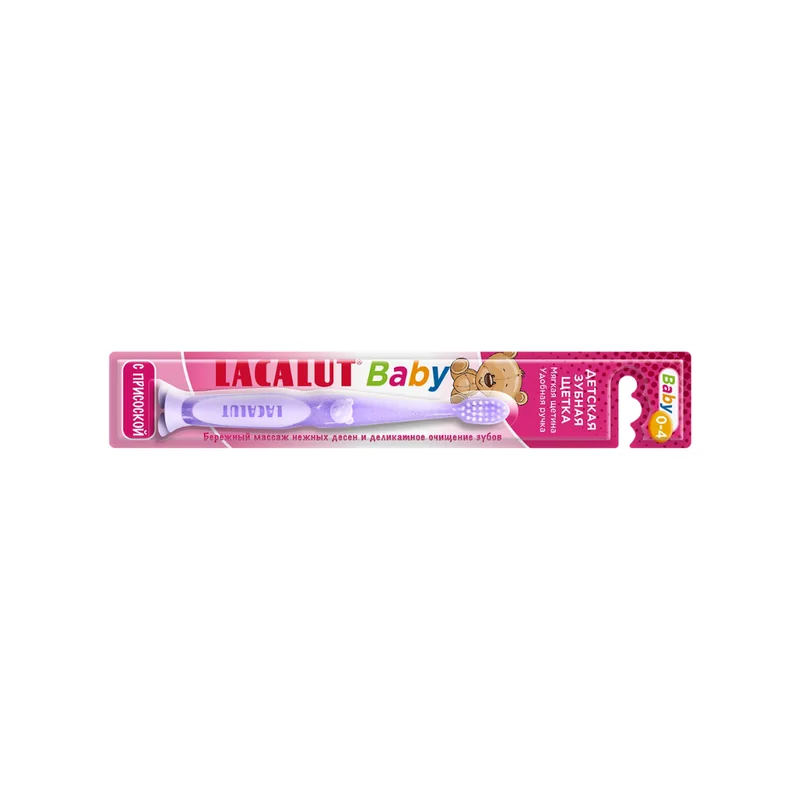 Lacalut Baby toothbrush
from birth to 4 years
soft · safe rubberized head
Lacalut Baby toothbrush
from birth to 4 years
soft · safe rubberized head
Soft, evenly trimmed bristles thoroughly remove plaque from children's enamel. The safe rubberized head protects toddlers from injury when they brush on their own, and the suction cup in the base keeps the brush stored hygienically between uses. The handle is comfortable for both child and adult to hold.
-
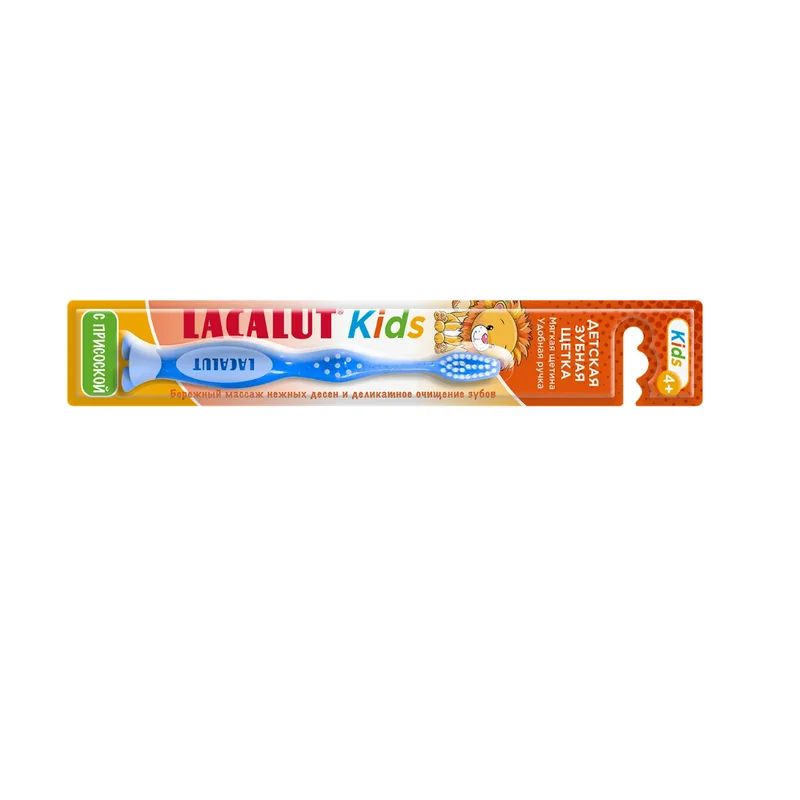 Lacalut Kids toothbrush
from 4 years
soft · for mixed dentition
Lacalut Kids toothbrush
from 4 years
soft · for mixed dentition
Ideal during the mixed dentition period: the rounded bristles of the main layer thoroughly remove plaque, while the longer tapered ones massage sensitive gums. A suction cup in the base for hygienic storage. The handle is comfortable for both child and adult to hold.
The basic sub-line is affordable care with fluorides, hydroxyapatite and panthenol.
Why a kids' toothpaste is not a scaled-down adult one
Two parameters change with age: how much fluoride the paste contains and how gently it cleans.
Fluoride grows with your child
Fluoride content, ppm · the older the child, the higher the dosage
Toddlers get a moderate dosage: they cannot spit out the paste yet. Once permanent teeth appear, the dosage rises to the adult level of 1400 ppm — the concentration the WHO recommends for reliable cavity protection.
Abrasiveness matched to enamel age
RDA index · the softer the enamel, the gentler the cleaning
Baby teeth are softer than permanent ones, so RDA is kept low in kids' pastes. For comparison: adult whitening pastes reach an RDA of up to 139. Where a range is given, the upper limit is shown.
How much paste by age
Toddlers swallow part of the paste, so the amount on the brush matters as much as the fluoride concentration.
A grain of rice
A smear of paste ≈ 0.1 g. An adult brushes, from the first tooth.
A pea
≈ 0.25 g. The child brushes, an adult finishes and supervises.
A 1–2 cm strip
Along the bristles. Twice a day for 2 minutes; after brushing spit, don't rinse.
Frequently asked questions about children's teeth
At what age should we start brushing?
From the first tooth — usually around 6 months. A soft brush and an age-appropriate paste in a rice-grain amount. No need to wait until two: first tooth — first brush — first paste.
How much paste is needed?
Under 3 — a rice-grain smear (≈ 0.1 g), 3–6 years — a pea, over 6 — a 1–2 cm strip. The amount matters as much as the fluoride concentration: children's norms assume that part of the paste is swallowed.
What if my child swallows the paste?
Swallowing an age-appropriate portion once is safe — concentrations in children's pastes are designed with this in mind. A large amount from the tube is another matter: then see a doctor. Keep the tube out of reach and brush together.
Should we rinse after brushing?
Better not to rinse — just spit out the excess. That way fluoride stays on the enamel longer and keeps working after brushing. This is what paediatric dentists in Europe recommend.
How often should we change the toothbrush?
Every 2–3 months, and also if the bristles splay or the child has been ill. LACALUT Baby and Kids brushes have soft bristles and a small head sized for a child's jaw.
Can a child use an adult toothpaste?
Under 6 — no: the fluoride dose and abrasiveness of adult pastes assume the user does not swallow paste. From 6 years 1400–1450 ppm fluoride is acceptable, but better in a children's formula with low RDA — Junior 6+, Teens 8+ or Teens 9–13. Whitening pastes and pastes with SLS are not suitable for children.
Fluoride and fluorosis: what should we really worry about?
Fluorosis is a disturbance of enamel formation caused by a systematic excess of fluoride over several years, not by swallowing paste once. That is why the dose and the amount of paste are regulated by age. Used as recommended, a fluoride toothpaste is the main protection against caries, especially in Belarus, where drinking water is low in fluoride. Read more in "Fluoride: myths and facts".
Is fluoride needed if the paste already contains hydroxyapatite?
Yes. Fluoride is the first line of caries prevention according to the WHO and the European Academy of Paediatric Dentistry; hydroxyapatite helps repair micro-damage to enamel. They complement each other, which is why LACALUT children's pastes contain both. Read more in "Hydroxyapatite and fluoride".
What the children's formulas are based on
Fluoride is the first line of defence
A 2019 Cochrane review (96 studies, over 60,000 children): pastes with 1000 ppm fluoride or more reduce caries increment compared with fluoride-free pastes. The European Academy of Paediatric Dentistry recommends a fluoride toothpaste from the first tooth, in an age-appropriate dose.
The form of fluoride matters when brushing is short
The amine fluoride Olaflur spreads over the enamel in the first seconds of brushing and forms a depot that keeps releasing fluoride after the paste is spat out. For a child who brushes for half a minute, this is more practical than the "slow" forms.
Hydroxyapatite is enamel's own mineral
It is the same mineral enamel is mostly made of. In a toothpaste it builds into micro-defects and complements fluoride: one strengthens, the other helps repair.
Mild surfactants instead of SLS
In some children sodium lauryl sulfate irritates the mucosa. LACALUT children's pastes replace it with mild surfactants, in several formulas with Poloxamer 188, which is also used in medicinal products.
- Walsh T. et al. Fluoride toothpastes of different concentrations for preventing dental caries. Cochrane Database of Systematic Reviews, 2019
- Toumba K. J. et al. Guidelines on the use of fluoride for caries prevention in children: an updated EAPD policy document. Eur Arch Paediatr Dent, 2019
- LACALUT toothpaste formulations — official data of Dr. Theiss Naturwaren GmbH
Reading for parents
How to choose a toothpaste for your child
Age, fluoride, RDA, hydroxyapatite and SLS-free surfactants — a checklist.
Read → 💧ExplainedFluoride: myths and facts
Fluorosis, "poison", fluoride-free pastes — and how much fluoride a child needs.
Read → 🔬ScienceWhat is Olaflur
The amine fluoride that gets to work during a short children's brush.
Read →Not sure what to choose for your child?
The children's branch of our quiz: age, whether they can spit, what worries you — and a recommendation in a minute.